
September 2, 2026
How to Calculate Cost Per Booked Glass Job
Learn how to calculate cost per booked glass job, separate leads from real opportunities, and measure Google Ads, SEO, and auto glass lead performance.
Key Takeaways
- Cost per booked glass job equals total marketing cost divided by jobs actually scheduled.
- A phone call, form fill, or map pack click isn’t a booked job.
- Track board-up calls, storefront bids, IGU replacements, and auto glass work separately.
- Include ad spend, management, landing pages, call tracking, and sales labor in your total cost.
- Google Ads can count calls by duration, but your shop should track calls that become appointments.
- A service-area page and a verified Google Business Profile help connect local demand to booked work.
What’s the cost per booked glass job?
The cost per booked glass job uses total marketing and sales cost. Divide it by jobs scheduled during that period.
Use this formula:
Cost per booked job = total acquisition cost ÷ booked jobs
That answer is different from cost per lead.
A glass lead is a person who contacts your company about a possible glass job. A booked job is a qualified opportunity with a scheduled visit, replacement, repair, board-up, or installation date.
That difference matters in Dallas, Houston, Austin, and other competitive Texas markets. A storefront owner may request three bids. A homeowner may call five shops after a seal failure. An auto glass customer may only ask about insurance.
Your marketing report should show what happened after the first contact.
Start with one month of data. Use the same dates for ad spend, calls, forms, estimates, and booked work.
The problem we see most is simple: shops count inquiries as sales. A missed call, duplicate form, or price shopper shouldn’t inflate your booked-job total.
Then calculate these five numbers:
- Total marketing cost.
- New glass inquiries.
- Qualified opportunities.
- Estimates or site visits.
- Booked jobs.
The last number controls your real acquisition cost.
Which costs belong in the calculation?
Your cost per booked job should include every direct cost required to create and handle the opportunity.
| Cost item | What to include | Why it matters |
|---|---|---|
| Google Ads spend | Search, call, and location campaign charges | Paid clicks create the first cost |
| Agency or management fee | Monthly campaign or marketing fee | A low ad cost can hide a high total cost |
| Website work | Landing page, service-area page, and conversion updates | Better pages can turn more inquiries into calls |
| Call tracking | Tracking number and recording platform | It ties calls to campaigns and outcomes |
| Sales labor | Time spent answering, qualifying, measuring, and quoting | Unanswered calls don’t become booked jobs |
| Lead fees | Marketplace or shared-lead charges | Shared inquiries can carry extra competition |
| Follow-up | Texts, emails, callbacks, and estimate reminders | Many commercial bids need more than one contact |
A simple ad-only calculation can help you compare campaigns. It shouldn’t be your final business number.
For example, a Google Ads campaign may show a cost per lead. That figure doesn’t include your management fee or the time spent chasing a commercial glazing bid.
Use two views:
- Channel cost per booked job: ad spend divided by jobs from that channel.
- Blended cost per booked job: all acquisition costs divided by all booked jobs.
The channel figure helps you compare Google Ads, local SEO, referrals, and lead marketplaces. The blended figure tells you what customer acquisition costs across the whole shop.
For more background on published lead pricing, see our guide to how much glass company leads cost. You can also compare that view with our local SEO guide for contractors.
How do you separate a lead from a booked job?

Separate each inquiry by source, service, quality, and outcome.
A qualified glass opportunity has a real service need, a workable location, and a reasonable chance of becoming revenue. A name and phone number alone don’t meet that standard.
Use these lead stages:
| Stage | Example | Count as a booked job? |
|---|---|---|
| Inquiry | “Can you replace my broken pane?” | No |
| Qualified lead | Address and glass type confirmed | No |
| Estimate | Site visit or quote scheduled | No |
| Approved work | Customer accepts the quote | Not yet |
| Booked job | Date and scope entered on the schedule | Yes |
| Completed job | Work finished and invoiced | No, track separately |
This model works across different glass services.
- Board-up: the caller needs a rapid response and gives a valid address.
- Storefront glass: the manager sends dimensions, photos, or schedules a site measure.
- IGU replacement: the customer confirms fogging between panes and requests a quote.
- Commercial glazing: the contractor shares plans, bid dates, and scope.
- Auto glass: the vehicle, glass type, location, and appointment window are confirmed.
An insulated glass unit (IGU) is two or more panes sealed around a spacer. Permanent fogging can signal seal failure and lost thermal performance, according to this explanation of insulating glass failures.
Don’t combine every service into one average. A board-up call and a curtain wall bid follow different sales paths. Their booking rates and job values differ too.
That’s also why auto glass leads deserve their own campaign and report. They often involve mobile service, insurance questions, vehicle fitment, and faster scheduling.
What numbers should a glass shop track each week?
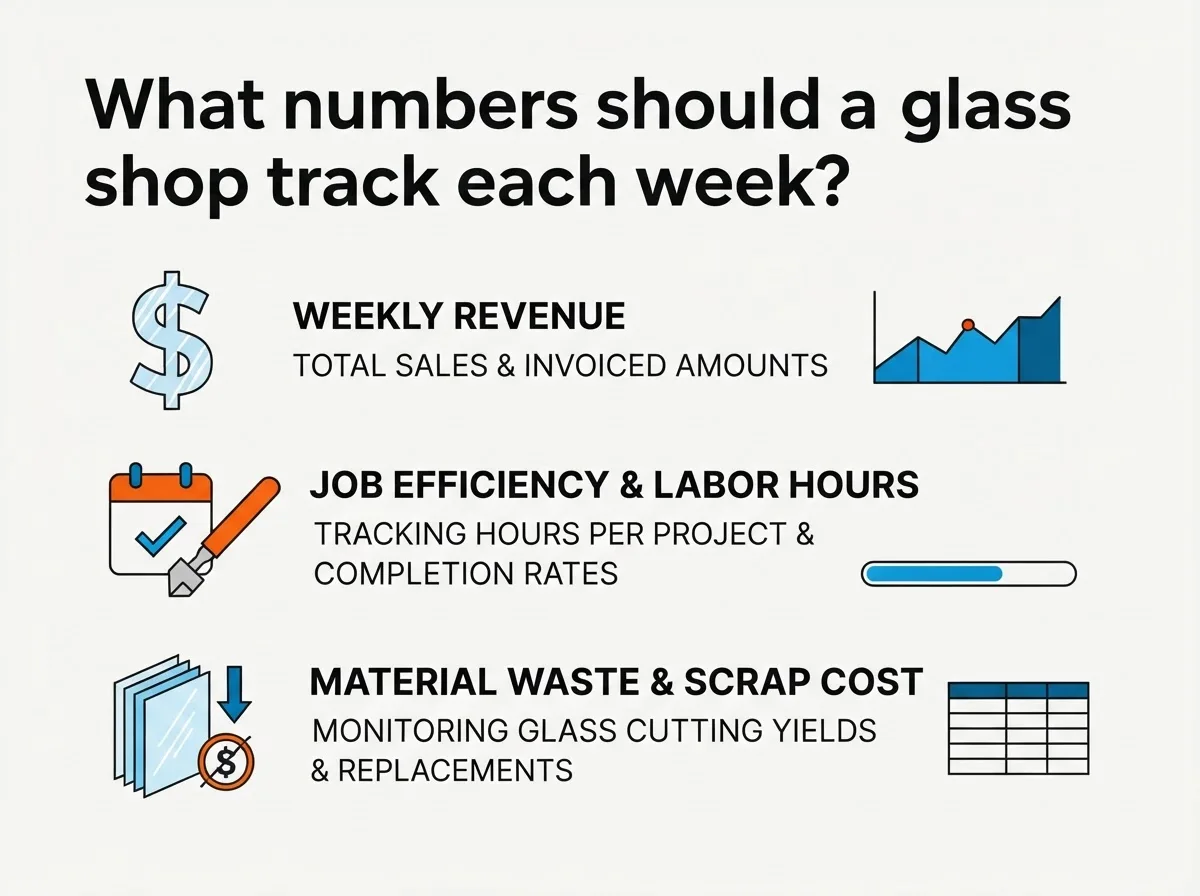
Track the full path from search to schedule.
Your basic spreadsheet can use these columns:
| Date | Source | Service | New leads | Qualified | Estimates | Booked | Revenue |
|---|---|---|---|---|---|---|---|
| Week ending | Google Ads, SEO, referral | IGU, storefront, board-up, auto | Count | Count | Count | Count | Dollars |
Then add these formulas:
- Lead-to-qualified rate = qualified leads ÷ new leads
- Estimate rate = estimates ÷ qualified leads
- Booking rate = booked jobs ÷ qualified leads
- Estimate-to-book rate = booked jobs ÷ estimates
- Cost per lead = total source cost ÷ new leads
- Cost per booked job = total source cost ÷ booked jobs
- Revenue per booked job = revenue ÷ booked jobs
The booking rate exposes weak follow-up. If leads arrive but few jobs reach the schedule, the issue may be response time, service area, pricing, or qualification.
Google’s own call measurement can count calls that last beyond a duration you set. It can also use call recordings to identify higher-quality leads where available. Read the phone call conversion tracking guidance before treating every tracked call as a sale.
Your CRM or job calendar should remain the source of truth. Mark a job booked only after someone confirms the date and scope.
Use benchmarks as a planning reference, not a promise
Published search advertising data can show the pressure in home services. It can’t predict your shop’s result.
| Published benchmark | Figure | How to use it |
|---|---|---|
| Home services average CPC | $7.85 | Compare click costs |
| Doors and windows sales average CPC | $8.76 | Watch window and glass-related competition |
| Doors and windows sales average CPL | $200.34 | Set a lead-cost warning point |
| Doors and windows sales average conversion rate | 4.41% | Review landing pages and intent |
These are search advertising benchmarks, not glass-shop guarantees. Your Houston storefront campaign may behave differently from a residential window campaign in San Antonio.
The one number to remember is $200.34, the published average cost per lead for the Doors and Windows Sales category. Use it as a comparison point, not as your target or expected result.
A lead costing that amount can still work for a profitable commercial job. It may not work for a small single-pane repair.
How should you measure Google Ads, SEO, and referrals?
Give every source a consistent name and a clear conversion action.
For Google Ads, track:
- Campaign and keyword.
- Phone calls.
- Form submissions.
- Direction requests.
- Service requested.
- Qualified opportunities.
- Booked jobs.
- Completed revenue.
For local SEO, track the Google Business Profile, organic service pages, and map pack actions separately. Google says Business Profile performance can show searches, views, calls, website clicks, messages, and bookings. It also says the data can include both organic results and Google Ads.
Review the Business Profile performance metrics each month. Treat calls and website clicks as actions, not booked work.
A map pack is the local search section that displays business profiles near the searcher. Ranking there can create calls without a direct click charge. You still need call tracking and booking records to measure the outcome.
For SEO, build a service-area page for each real market you serve. A service-area page is a location page that explains a specific service, response area, and customer problem.
A strong page might target:
- Commercial storefront glass in Fort Worth.
- Board-up glass service in Houston.
- IGU replacement in Plano.
- Auto glass leads in Austin.
- Curtain wall repair for Dallas contractors.
Don’t publish thin city pages with swapped place names. Show service details, response limits, glass types, photos, and a clear call button.
Our guide to local SEO for contractors covers the local visibility side. For paid campaigns, see Google Ads for contractors.
How do you improve the number after you calculate it?
Lower cost per booked job by fixing the stage where prospects drop out.
If clicks are expensive, review keyword intent and negative keywords. Remove searches for DIY work, glassware, leaded glass, jobs, training, and unrelated products.
If calls are coming from outside your area, tighten location settings and rewrite the service area in the ad.
If calls aren’t answered, fix the phone process before increasing the budget. Use a live answering plan during board-up hours and a clear after-hours message.
If estimates aren’t booking, improve the sales handoff. Send a written scope, explain tempered vs. annealed glass where relevant, and give the customer a clear next step.
A thermal break is a low-conductivity barrier that reduces heat transfer through a frame. A low-E coating is a thin coating that limits heat transfer through glass. Customers may ask about both during residential window or storefront discussions.
For energy-focused replacement work, explain the performance data rather than making vague promises. ENERGY STAR provides guidance on certified residential windows, doors, and skylights in its official residential window guidance.
For commercial work, qualify the scope early. A storefront system, curtain wall, spandrel glass panel, and IGU replacement need different labor, access, and ordering steps.
Review the report every week. Look for:
- Leads with no call outcome.
- Estimates with no follow-up date.
- Calls marked as conversions but not booked.
- Service types with poor booking rates.
- Campaigns producing inquiries outside your service area.
- High-value jobs that need a separate sales process.
When your data is clean, you can raise the budget with less guesswork. You’ll know whether you’re buying clicks, inquiries, estimates, or booked jobs.
For a second paid-search checklist, review our guide to Google Ads for contractors.
Want a cleaner view of your booked-job cost?
Book a GlassLeadsEngine demo to review your lead sources, call tracking, local SEO, and Google Ads against booked work. We’ll focus on the numbers that reach your schedule, not vanity totals.
FAQ
What’s the difference between cost per lead and cost per booked job?
Cost per lead measures the price of a new inquiry. Cost per booked job measures the price of a scheduled job.
Calculate the first by dividing source cost by inquiries. Calculate the second by dividing source cost by confirmed appointments. The booked-job figure is better for staffing and budget decisions.
How do I track whether a glass lead became a job?
Track each lead in a CRM, spreadsheet, or job system. Record source, service, location, qualification, estimate date, booking date, and revenue.
Use call tracking for phone inquiries. Mark a lead as booked only after the customer confirms the scope and appointment time.
Should auto glass leads use a separate cost calculation?
Auto glass leads should have a separate calculation because the sales process differs. Track vehicle details, insurance status, mobile location, glass availability, and appointment time.
Compare auto glass cost per booked job with other auto glass jobs. Don’t compare it with storefront bids or commercial glazing work.
What should I include in total marketing cost?
Include ad spend, agency fees, website and landing-page work, call tracking, lead fees, and direct sales labor.
Use one consistent period for costs and bookings. Excluding these inputs makes your reported cost per booked job lower than your shop’s actual spend.
Sources
Get Your Free Demo Page Built in 48 Hours
No credit card. No commitment. We'll build a full lead-gen landing page for your glass business — specific to your city.