
August 12, 2026
How Much Do Glass Company Leads Cost in the United States?
Glass company leads can cost very different amounts. Learn realistic lead costs, what changes them, and how to judge Google Ads, SEO, and auto glass leads.
How Much Do Glass Company Leads Cost?
Key Takeaways
- A glass lead may cost less through local SEO, but SEO takes longer to build.
- Google Ads gives faster demand, but competition changes your cost per lead.
- Commercial glazing leads need better qualification than residential repair calls.
- Auto glass leads need different keywords, landing pages, and call handling.
- The best lead isn’t the cheapest one. It’s the one that can become a profitable job.
- Call tracking shows which campaigns produce real conversations and booked estimates.
A glass company lead usually costs from a modest amount through organic search to much more through paid search. Your market, service, job value, and lead quality decide the real number.
The term “glass leads” is also messy. Some searches mean architectural leaded glass. Others mean sales opportunities for a glazing business. This article covers the buyer intent: winning residential, commercial, storefront, window, and auto glass work in the United States.
What does a glass company lead cost?
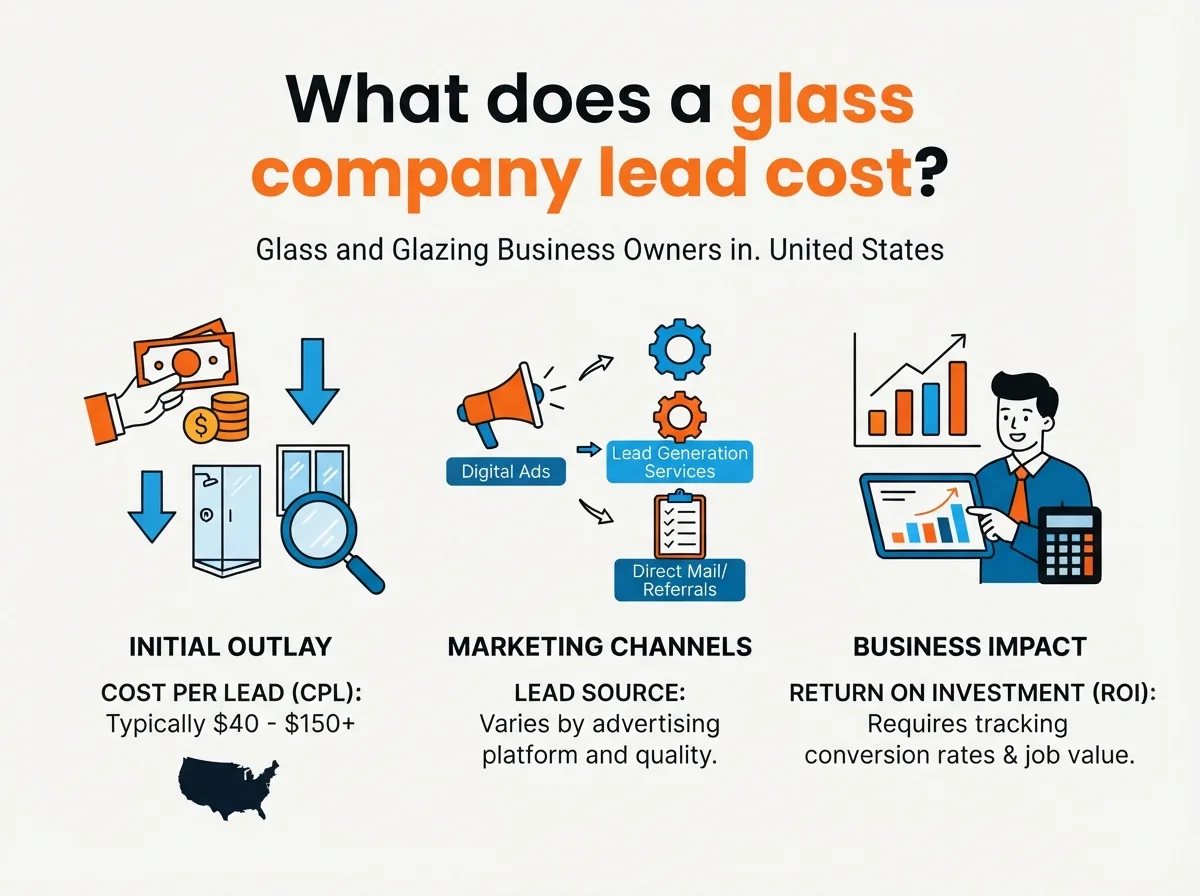
A glass company lead is a customer enquiry from someone seeking a glass-related service. It may arrive through a phone call, form, Google Business Profile, map pack listing, or paid advertisement.
There isn’t one national price for a glass lead. A board-up call in Houston behaves differently from a curtain wall enquiry in Dallas. An auto glass replacement call also follows a different path from an IGU replacement estimate.
As a paid search reference, the 2025 benchmark for Doors & Windows Sales reported an average cost per lead of $200.34. That figure isn’t a promise for glass companies. It shows why broad home-service benchmarks need careful interpretation.
| Lead source | What you pay for | Best fit | Main risk |
|---|---|---|---|
| Google Ads | Clicks and campaign management | Urgent repairs and defined services | Irrelevant searches |
| Local SEO | Website and ongoing optimisation | Steady local demand | Slow build time |
| Google Business Profile | Visibility and enquiry handling | Local service areas | Weak profile signals |
| Referral | Relationships and follow-up | Commercial and repeat work | Limited volume |
| Third-party lead | An enquiry or shared opportunity | Extra short-term demand | Poor fit or multiple bidders |
We don’t treat a benchmark as your target. We first separate profitable services from low-value enquiries. Then we track the source, service, location, and outcome.
A small pane replacement and a commercial storefront project should not share one target. Their sales time, travel, quoting process, and profit potential differ.
Why do glass leads cost more in some markets?
Glass lead costs rise when more companies compete for the same high-value searches. Emergency intent, dense metros, expensive commercial work, and limited search volume can all increase the price of acquiring an enquiry.
Texas markets show this clearly. Houston has storm damage, board-up calls, and large suburban service areas. Dallas-Fort Worth has residential replacement, commercial construction, and fast-growing suburbs. Austin has remodel work and higher competition for visible local searches.
The service changes the economics too:
- Board-up: Fast response matters. The caller often chooses the first credible company.
- IGU replacement: Customers may compare quotes and ask about seal failure.
- Storefront glass: The buyer may be a business owner, property manager, or contractor.
- Curtain wall: The lead may involve drawings, specifications, takeoffs, and bid deadlines.
- Auto glass: Mobile service, insurance questions, and vehicle details matter.
- Window replacement: The sale may involve several windows and a longer decision cycle.
A storefront system is a framed commercial glazing assembly. A curtain wall is a non-load-bearing exterior wall system that transfers wind loads to the building structure.
Those projects need different landing pages and forms. A generic “glass company” page won’t qualify them well.
For replacement work, homeowners may ask about tempered vs. annealed glass, low-E coating, thermal break design, or U-factor. A U-factor measures how quickly heat passes through a window or glazing product. Lower values generally indicate better insulation.
The window performance criteria by climate zone use U-factor and solar heat gain requirements. That gives your website a useful way to answer Texas-specific buying questions.
Your content should connect the technical detail to the job. Explain why low-E coating may matter in a hot climate. Explain why a failed IGU needs inspection rather than a generic replacement quote.
Which type of glass lead is worth paying for?

The most valuable lead is one that matches your service, territory, capacity, and minimum job size. Cost per lead should be judged beside close rate, gross profit, travel time, and the time needed to quote.
A lead for an emergency repair and a lead for a commercial project shouldn’t share one campaign. They need separate budgets, ad groups, forms, and follow-up.
Use these qualification fields:
- Service needed.
- Property type.
- Job location.
- Approximate size.
- Photos or drawings.
- Required completion date.
- Insurance or builder involvement.
- Preferred contact method.
An insulated glass unit, or IGU, is a sealed assembly with two or more panes and a spacer. A seal failure can cause fogging, moisture, or reduced insulating performance.
IGU components and certification requirements include glass, spacers, sealants, desiccants, gas fill, and coatings. That technical detail helps your content match real replacement searches.
For commercial jobs, build pages around terms such as:
- Commercial glazing bids
- Storefront glass replacement
- Curtain wall repair
- Spandrel glass
- Tenant improvement glazing
- Glass replacement for property managers
Spandrel glass is opaque or translucent glass used to conceal areas between vision sections, floors, or structural elements. It often appears in commercial façades and curtain wall systems.
A page that names these services can produce fewer enquiries but better-fit enquiries. It also gives estimators a better starting point before the first call.
Commercial glazing Google Ads should focus on the work you can quote and complete. Remove services that create enquiries but rarely become jobs.
Are auto glass leads priced differently?
Auto glass leads follow a different sales model because speed, location, vehicle details, and insurance often decide the booking. A campaign for auto glass leads should not share a landing page with architectural glazing or commercial glass.
Use separate pages for:
- Windshield replacement
- Windshield repair
- Door glass
- Back glass
- Fleet vehicle glass
- Mobile auto glass
- ADAS-related questions
Auto glass leads are often urgent. The caller may be standing beside a damaged vehicle. Your page should show service locations, opening hours, mobile coverage, phone number, and the next step.
Don’t send every search to one contact form. Ask for the vehicle year, make, model, glass needed, location, and preferred appointment time.
Negative keywords can protect the budget. Google defines a negative keyword as a term that prevents an ad from showing for a particular search. Add irrelevant terms such as DIY, jobs, training, wholesale, and decorative searches where they don’t match your offer. See the negative keyword definition before building your list.
“my glass leads” is another search phrase owners may see in reports. Treat it as a query to inspect, not as a marketing strategy. Check whether the searcher wants a lead provider, a glass supplier, or a local glazing contractor.
Auto glass owners should also separate mobile searches from shop searches. A customer searching from a roadside location needs a fast phone option. A fleet manager may need a form with account details and service coverage.
How can you lower the cost per lead?
Better targeting lowers wasted clicks before you need more traffic. Start with the services you can sell profitably, then build campaigns around location, urgency, and job type.
1. Fix the service page
Each page should answer:
- What glass work do you handle?
- Which cities do you serve?
- Do you offer emergency response?
- Do you work on homes, shops, offices, or construction sites?
- What photos or measurements should the customer send?
- How quickly will someone respond?
A service-area page is a page built for a defined location and service combination. “Commercial storefront glass in Houston” is more useful than a generic page listing every Texas city.
The page should also show proof. Add completed work, customer reviews, service limits, and a clear phone number. Don’t hide the next step below several screens of text.
2. Protect the paid budget
Use clear service themes. Separate emergency repair from planned replacement. Keep residential, commercial, and auto glass campaigns apart.
Review search terms every week. Add negative keywords when irrelevant searches appear. Pause locations that produce calls outside your service radius.
Google Ads for contractors covers the wider campaign structure. For a glass company, add service-specific exclusions and landing pages.
3. Improve local visibility
A Google Business Profile helps customers find your business on Google Search and Maps. Complete service details, photos, hours, service areas, and review responses support a stronger local presence.
Google’s local ranking guidance points businesses toward relevance, distance, and prominence. Those factors matter for a glass company serving a wide area.
Link your profile to the right service page. Don’t send every visitor to the homepage.
Local SEO for contractors explains the wider local search process. Apply it to actual glass services, not broad city pages with no useful detail.
4. Track calls properly
Call tracking records which campaign, page, or listing produced a call. Mark calls as qualified, unqualified, quoted, booked, or missed.
A form submission alone doesn’t prove lead quality. A missed board-up call may be more valuable than several low-intent forms.
Review calls by service and location. You may find that one suburb produces strong IGU work while another produces only price shoppers.
5. Respond while the customer is still looking
The FTC describes lead generation as a process where consumer information can become the product. Its guidance on consumer data in lead generation shows why businesses should understand how enquiries are collected, shared, and used.
Ask any third-party provider:
- Is the lead exclusive or shared?
- What service and location created it?
- How quickly is it delivered?
- Can you dispute duplicates?
- Has the customer consented to contact?
- Who owns the data?
We see the same problem often: owners compare lead prices but don’t compare lead definitions. One provider may count a form. Another may count a live phone conversation. Those aren’t equal.
For more planning help, read how to get more leads for a glass company. Then compare that approach with our SEO services for local businesses.
Should you buy leads or build your own pipeline?
Building your own pipeline gives you more control over quality, branding, and follow-up. Buying third-party leads can add volume, but shared enquiries may create price pressure and poor customer experience.
A sensible mix often includes:
- Google Ads for urgent and high-intent services
- Local SEO for recurring local searches
- A strong Google Business Profile for map pack visibility
- Referral follow-up for builders and property managers
- Remarketing for customers who need time to compare
Your website should support all five sales paths. A homeowner replacing a fogged IGU needs different proof from a general contractor pricing spandrel glass.
Use project photos, service locations, response times, certifications, and clear contact options. Avoid vague claims about being the best. Show the work.
Don’t judge marketing by leads alone. Compare qualified calls, estimates, booked jobs, average job value, and gross profit. That view tells you which source deserves more budget.
Our lead generation services combine website design, local SEO, and Google Ads around the jobs you want. We focus on measurable enquiries, not traffic for its own sake.
Book a lead generation review to estimate a workable cost per lead for your market, services, and job sizes. We’ll help you separate useful demand from wasted spend.
FAQ
How to promote glass business?
The strongest starting mix is a clear service website, a complete Google Business Profile, local SEO, and focused Google Ads. Create separate pages for board-up, IGU replacement, storefront glass, commercial glazing, and auto glass. Add service locations, project photos, call tracking, and a fast response process.
Can you tell if glass has lead in it?
A visual check usually can’t confirm lead content or lead-based paint around a glass job. Older buildings may contain lead-based paint near windows and doors. Follow applicable EPA work practices when disturbing painted surfaces. Installation guidance also directs contractors toward lead-safe practices for older homes.
How much does lead glass cost?
“Lead glass” can mean decorative leaded glass, not a sales lead for a glazing company. Pricing depends on design, size, restoration, framing, and installation. For marketing, use clearer terms such as glass company leads, commercial glazing leads, or auto glass leads.
How do I know if a glass lead is good?
A good lead matches your service, territory, job value, and available schedule. Confirm the location, glass type, photos, urgency, property type, and decision-maker. Then track whether the enquiry became a quote or booked job. Cheap leads that cannot become profitable work aren’t good leads.
Sources
Get Your Free Demo Page Built in 48 Hours
No credit card. No commitment. We'll build a full lead-gen landing page for your glass business — specific to your city.