August 19, 2026
Exclusive vs Shared Leads for Glass Companies: Which Wins More Jobs?
Compare exclusive and shared glass leads, including auto glass leads, response speed, lead quality, costs, and the best choice for your shop.
Key Takeaways
- Exclusive glass leads go to one company. Shared leads go to several.
- Exclusive leads fit urgent board-up, storefront glass, and high-value commercial work.
- Shared leads can help fill a slow schedule, but speed matters more.
- A lead only has value if it matches your service area and glass work.
- Your best long-term mix combines Google visibility, paid search, and clear lead tracking.
- Auto glass leads need different messaging from residential and commercial glazing leads.
Exclusive vs. shared glass leads: what’s the difference?

Exclusive glass leads go to one glass company. Shared leads go to multiple companies, often at the same time. Exclusive leads usually cost more, but they give your shop a better chance to speak with the customer first.
That difference matters on a broken storefront, emergency board-up, or insurance-related auto glass job. The customer wants help now. They rarely wait for five shops to call.
A glass lead is a customer inquiry about a glass service. It might involve a replacement insulated glass unit, a shower enclosure, a storefront system, a curtain wall repair, or auto glass.
The label alone doesn’t tell you whether the lead is good. You still need to check:
- The customer’s location
- The service requested
- The job timeline
- Whether the customer wants a quote or a repair
- Whether the phone number works
- Whether the inquiry fits your crew and equipment
A lead for a cracked residential pane in Dallas isn’t the same as a commercial glazing bid in Houston. It also isn’t the same as an auto glass lead for a windshield replacement.
How do exclusive glass leads work?
Exclusive leads give one company the first chance to contact a buyer. The lead source sends the inquiry to your shop without sending that same inquiry to nearby competitors.
That setup creates a cleaner sales process. Your estimator can ask about measurements, access, glass type, and timing without racing another company.
Exclusive leads work best when the job needs knowledge and trust. Examples include:
- IGU replacement after seal failure
- Tempered vs. annealed glass recommendations
- Low-E coating questions
- Custom shower glass
- Storefront glass replacement
- Curtain wall or spandrel glass work
- Commercial glazing bids
- Emergency board-up calls
A customer may not know the right product name. They may say, “The window is foggy,” when the real issue is a failed seal inside an insulated glass unit.
Your team needs time to diagnose the problem. A rushed call often produces a weak quote or a missed opportunity.
The technical details also affect the sale. The Federal energy guidance on U-factors explains that window performance depends mainly on U-factor and solar heat gain coefficient. That gives your estimator useful language for energy-conscious replacement work.
Exclusive delivery also makes follow-up easier. You can send photos, measurements, and notes to one sales process. You don’t need to guess whether another company already promised a lower price.
Benefits of exclusive leads
- Less direct price pressure
- More time to qualify the job
- Better fit for complex glass work
- Easier call tracking
- Clearer ownership inside the shop
- Better customer experience when the response is fast
Exclusive doesn’t mean automatic revenue. A missed call can still lose the job. So can a slow quote, unclear service area, or poor phone handling.
What happens with shared leads?
Shared leads send one customer inquiry to more than one glass company. The buyer may receive several calls, texts, or emails within minutes.
Shared leads often appeal to shops watching their budget. They can produce more opportunities without requiring a large marketing program. They can also create more work for the office.
The customer may compare every caller on price. Some callers won’t answer. Others may already have a quote before your team reaches them.
Shared leads can still make sense for straightforward work. A shop with open capacity may accept them for:
- Basic window glass replacement
- Mirror work
- Shower door repairs
- Small residential repairs
- Routine windshield replacement
- Lower-complexity service calls
Auto glass leads need special handling. The customer often wants a fast appointment, insurance guidance, or mobile service. Your intake process should ask for the vehicle year, make, model, glass location, and calibration needs.
The Bureau of Labor Statistics describes automotive body and glass repairers separately from building glaziers. Its glazier occupation guide also covers storefront windows, insulated glass, architectural systems, and commercial work. That distinction matters when you judge whether a shared lead fits your shop.
Problems with shared leads
- Several companies may call the same buyer
- The customer may focus on the lowest quote
- Lead freshness can vary
- Your office spends more time sorting inquiries
- Duplicate or incomplete details can waste crew time
- Complex commercial work may not fit a quick lead form
“My glass leads” isn’t a useful category by itself. The real question is whether those leads are exclusive, shared, qualified, and matched to your service area.
Which lead type fits each glass service?
The best choice depends on job value, urgency, technical difficulty, and your available capacity.
| Glass service | Better starting point | Why |
|---|---|---|
| Emergency board-up | Exclusive | Speed and trust matter during a break-in or storm |
| Storefront glass | Exclusive | Measurements, access, framing, and safety affect the quote |
| IGU replacement | Exclusive or tightly qualified shared | Seal failure needs diagnosis and accurate sizing |
| Commercial glazing bids | Exclusive | Plans, schedules, scope, and compliance require attention |
| Residential pane repair | Shared can work | The job may be simple and price-sensitive |
| Shower glass | Either | Fit, finish, and appointment timing shape the sale |
| Routine auto glass | Shared can work | Fast response and vehicle details often matter most |
| Complex auto glass | Exclusive | Calibration, specialty glass, and mobile access need care |
A qualified lead is an inquiry that matches your service, location, timing, and ability to take the job. Qualification matters more than the exclusive label.
For example, an exclusive inquiry outside your service area may be worthless. A shared inquiry from a nearby commercial property manager may be highly valuable.
We see this mismatch often: a shop buys a lead that sounds promising, then finds the property sits outside its normal crew route. The lead was exclusive, but it still wasn’t useful.
Create separate intake paths for building glass and auto glass. Don’t send every inquiry to one generic form.
For building work, ask about:
- Property type
- Glass location
- Approximate dimensions
- Frame or storefront details
- Damage or replacement reason
- Site access
- Desired completion date
For auto glass, ask about:
- Vehicle details
- Windshield, door glass, back glass, or quarter glass
- Insurance involvement
- Mobile or shop appointment
- Driver assistance features
- Calibration requirements
Your website should make those choices obvious. A focused website design service can separate residential, commercial, emergency, and auto glass paths.
How should a shop choose between exclusive and shared leads?
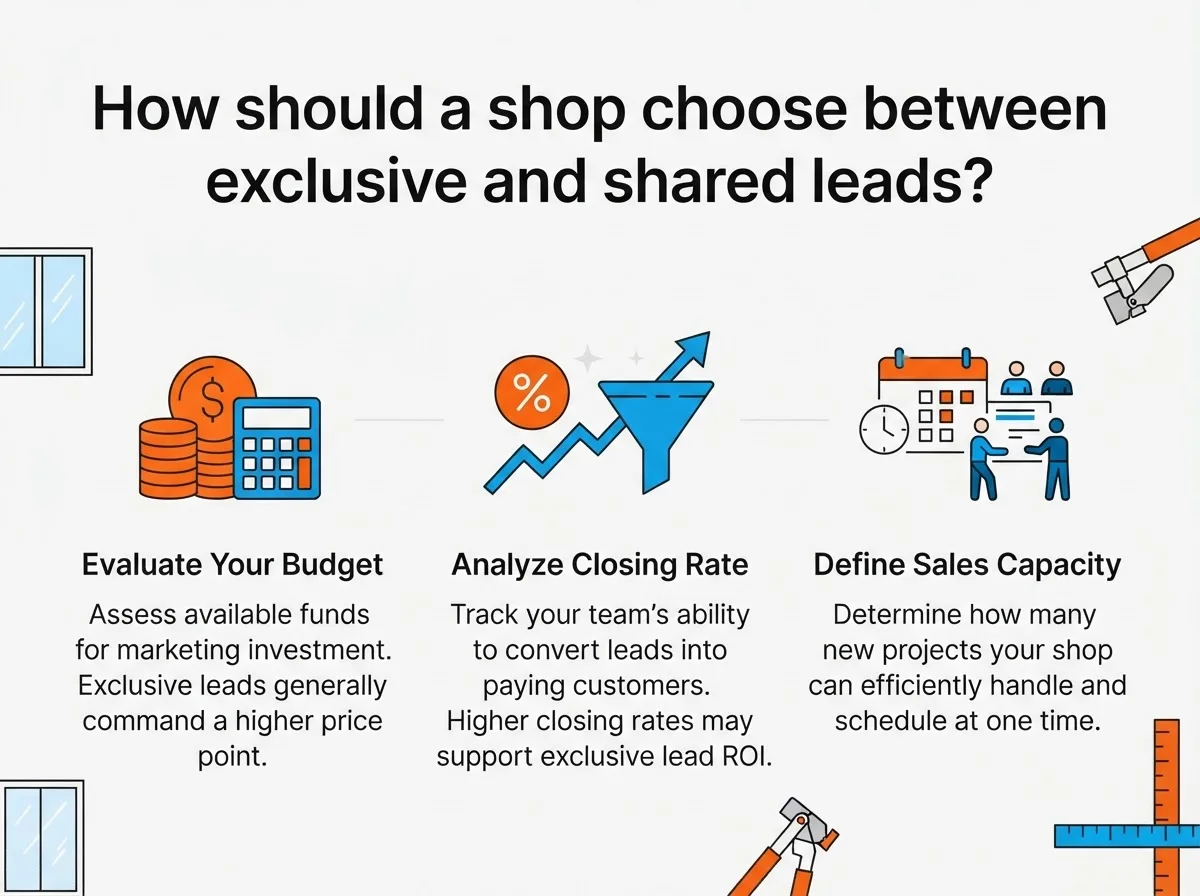
Choose exclusive leads for high-value or urgent work. Choose shared leads when you have spare capacity and a fast follow-up process. Review lead quality by booked jobs, not by inquiry volume.
Use this decision test before you buy any lead source:
- Exclusivity: Does it define exclusive clearly?
- Freshness: Does it show when the lead was created?
- Service fit: Does it identify the requested service?
- Location: Does it confirm the customer’s city or ZIP code?
- Disputes: Can you dispute duplicates or bad numbers?
- Delivery: Does it explain delivery by call, form, text, or email?
- Tracking: Can you track calls and booked jobs?
- Control: Can you stop leads for services you don’t offer?
Ask how long the provider waits before sending a shared lead to another shop. Ask whether a lead can be sold again later. Get the answer in writing.
Your own marketing also gives you more control. A Google Ads campaign for contractors can target searches such as “storefront glass repair near me” or “emergency board-up Houston.”
Use separate campaigns for separate jobs. Don’t combine “auto glass leads” with commercial glazing bids. Those customers need different ads, landing pages, questions, and follow-up.
Negative keywords help protect the budget. Google explains that negative keywords exclude searches that don’t match your offer. A building glass company might exclude windshield, car, DIY, glassware, and stained glass terms.
Your Google Business Profile should also match the work you actually perform. Google’s service-area guidance says service areas should describe where you provide services. It also recommends specific cities or postal codes instead of a vague radius.
That helps a Texas shop avoid paying for calls from areas its crews can’t reach. A shop serving Fort Worth, Arlington, and nearby communities should name those areas clearly.
A practical lead mix
A strong mix often looks like this:
- Exclusive leads for emergency and commercial work
- Shared leads for simple repairs during open capacity
- Local SEO for steady map pack visibility
- Google Ads for urgent, high-intent searches
- A service-area page for each meaningful market
- Call tracking tied to booked jobs
The local SEO guide for contractors covers the visibility side. Your Google Ads service can support demand when you need calls faster.
Track every lead through the same stages:
| Stage | What to record |
|---|---|
| Received | Source, time, service, location |
| Contacted | Call attempt and response |
| Qualified | Scope, timing, and fit |
| Quoted | Price, notes, and next step |
| Booked | Job type and scheduled date |
| Won or lost | Reason and competitor pressure |
This tells you whether a more expensive exclusive lead is producing better work. It also shows when shared leads are useful for filling gaps.
Don’t judge a source from one week of calls. Review patterns across service types. A source may perform well for board-up calls and poorly for commercial bids.
Does exclusive always beat shared for glass businesses?
No. Exclusive leads don’t always win. A well-qualified shared lead can beat an exclusive lead that arrives late, has the wrong service, or sits outside your coverage area.
The deciding factor is your operating system. If your phone goes unanswered, exclusive delivery won’t fix the problem. If your estimator takes days to quote, the customer may choose someone else.
Response speed matters most for emergency glass and auto glass. Technical follow-up matters more for IGU replacement, storefront systems, and commercial work.
A lead response system is the process that moves an inquiry from first contact to booked job. It should include a live answer or fast callback, clear questions, photo collection, quote timing, and follow-up reminders.
Make one person responsible for new inquiries during working hours. Give that person scripts for board-up, seal failure, storefront glass, and auto glass leads.
For commercial work, send a short confirmation after the call. Repeat the site address, scope, required measurements, and next step. That small habit prevents many quote errors.
For residential work, explain the likely process without promising a final price before seeing the glass. Customers respond better when they understand why size, thickness, coating, frame, and access affect the quote.
The glass company lead guide can help you build the wider demand plan. For a cost-focused review, see how much glass company leads cost.
The right answer usually isn’t “exclusive only” or “shared only.” It’s a controlled mix, matched to the job and measured through booked work.
Build a lead plan around your best jobs
Your shop should pay more attention to profitable work than raw inquiry totals. Exclusive leads suit jobs where trust, speed, and technical skill protect the sale. Shared leads suit simpler jobs and open schedule capacity.
Start with one service line. Track every call, quote, and booking. Then expand into nearby Texas cities only after the process works.
See how we build lead systems for glass companies that bring the right service inquiries to your shop.
FAQ
How can I promote a glass business?
Promote a glass business through local search, paid search, referrals, and clear service pages. Build separate pages for storefront glass, board-up, IGU replacement, shower glass, and auto glass. Keep your Google Business Profile accurate. Use photos, reviews, call tracking, and fast follow-up to turn visibility into booked work.
How do I attract customers to my glass business?
Attract customers by matching each service to a specific search and landing page. Use terms such as “storefront glass repair,” “emergency board-up,” or “windshield replacement.” Show your service area, response process, and phone number. Track calls by source, then improve the pages that produce qualified inquiries.
How can I get glass clients quickly?
Get glass clients quickly with tightly targeted Google Ads and a responsive phone process. Focus on urgent searches in the cities your crew serves. Add negative keywords for unrelated meanings of glass. Answer calls live when possible. Send missed-call alerts and follow up before the customer contacts another shop.
Are auto glass leads different from building glass leads?
Yes, auto glass leads need different questions, ads, and follow-up. Ask for the vehicle details, glass location, insurance status, mobile service needs, and calibration requirements. Building glass inquiries need property details, dimensions, frame information, and access notes. Separate campaigns keep both lead types more relevant.
Sources
Get Your Free Demo Page Built in 48 Hours
No credit card. No commitment. We'll build a full lead-gen landing page for your glass business — specific to your city.